
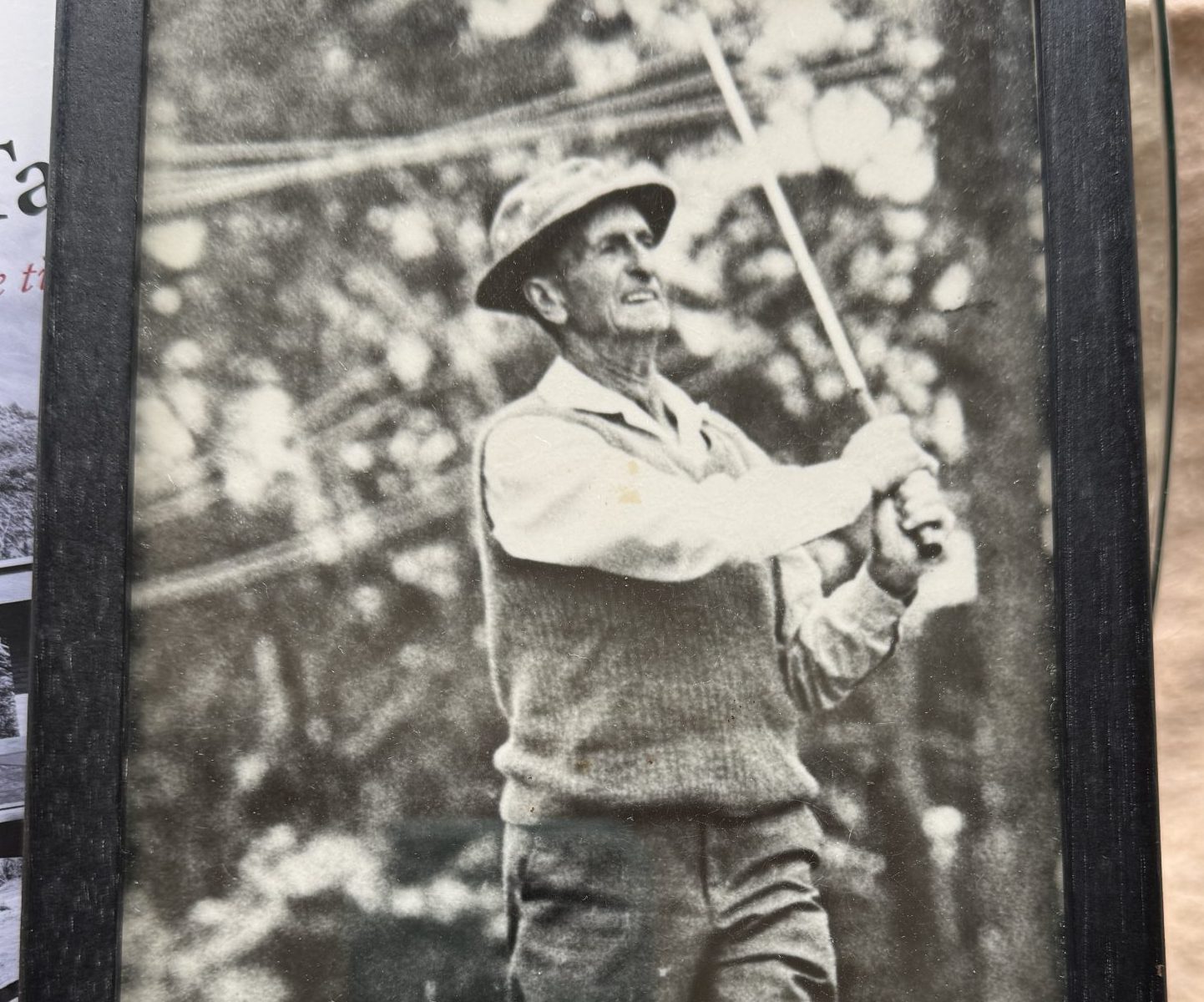
By Melissa Pouliot and Christine Kaine
Presented to Bega Valley Genealogy Society, 30 August 2026
As you drive around Merimbula, built around the ocean and a lake on the NSW Far South Coast, the street names follow a pattern you’d expect in a coastal town – from Beach Street to Lakeview Avenue to Lake and Cliff streets. The next-door town of Pambula’s street names – Merimbola, Toallo, Quondolla and Bullara – have their origins in the local Indigenous language.
But the road that links Merimbula with Pambula, starting at the Black Dolphin Motel, past the airport and the Pambula Merimbula Golf Course, is not named after a landmark or Indigenous language – it’s named after a person. Arthur Kaine.
As you drive along this main artery between Merimbula and Pambula, do you ever wonder who Arthur Kaine is and why he has such a prominent road named after him?
I was commissioned to write the history of Arthur Kaine by his daughter Christine Kaine. I have the advantage of knowing Christine for the past 13 years and hearing many stories about her father.
I started compiling photos, facts, dates and places, although from the outset I was way more interested in discovering the true character of this man. What motivated him to contribute so immensely to his community and beyond and how on earth did he manage to achieve all that he achieved?
I put out a call for photos, newspaper clippings, personal recollections and stories handed down from the older generations and sincerely thank those who contacted me with their memories of Arthur, who died in Merimbula on 17 March 1992, aged 88.
What I really would have loved is to have been able to sit down with those in Arthur’s friendship circle who are no longer with us. People like:
- Robin Boyd, CBE, Australia’s most influential architect who designed the Black Dolphin Motel and whose design influence is evident in an extension of Arthur’s family home.
- Professional golfer and course designer Peter Thompson, AO, CBE, who worked closely with Arthur to design and build the Tura Beach golf course. Peter was inducted into the Sport Australia Hall of Fame in 1985 and elevated to Legend of Australian Sport in 2001.
- Professor Emeritus David Yencken, AO, who worked in industry, politics and academia. Modest and unassuming, Yencken was a visionary thinker, brilliant entrepreneur, astute politician and discerning patron who built the Black Dolphin Motel and was a close family friend of the Kaine’s.
And of course, I would have loved to have sat down with Arthur’s wife, Peace, an active member and office bearer of the CWA for 43 years, a member of NSW Housing Commission Advisory Board for 12 years, district commissioner for the Girl Guides, life member of Merimbula & District Art Group, foundation vice president of Pambula-Merimbula Golf Associates, vice president of Merimbula Hospital Auxiliary and a Meals on Wheels volunteer.
Together, the couple have left a lasting legacy in the Bega Valley that my research will never be able to fully comprehend, and if they were here for me to interview, they would most likely downplay their achievements.
Peace once wrote: “We received back a great deal more than we ever contributed. Our association with other people – the friends we made, some of them lifelong – gave a sense of achievement both personally and as a community.”
I will now pass on this story for Arthur and Peace’s only daughter Christine to share, and it will go on public record so future generations will know when they drive along Arthur Kaine drive, why it is named as such.
Christine Kaine
My father was a very gentle, loving person and although he was away a lot working, when he was home we’d play Scrabble and cards – he didn’t really like it when I won! He was a very supportive father. My mother, Peace, was the same. They were very kind, giving people who both contributed amazingly to the community.
Arthur William Kaine was born into a sawmilling family at Ulverstone, Tasmania on 20 May, 1904, the son of James Kaine and Christina Maud Paton. When he moved to Merimbula after the Second World War in the mid 1940s with my mother Peace, his second wife, the population sign read 200.
My mother’s name comes from being born during an era of peace after the First World War. They met during the Second World War while both working for the Post Master General (PMG) in Sydney.
They purchased two blocks of land side by side in Lakeview Avenue, Merimbula, overlooking Back Lake and Short Point. I still live in the family home my father built.
Arthur had two daughters from his first marriage, Carmel and Margaret. Some may recognise the name Carmel Kaine from her illustrious career as an Australian classical violinist. Carmel, who died in 2013, had one child, Katharine, and Margaret, who is 96 now, has two children David (dec) and Elizabeth.
Kind, friendly man
Through Melissa’s research, others have described my father as a kind, friendly man with a keen business brain.
The Pambula Merimbula Golf Club, which opened in 1966, was one of my father’s proudest achievements. It was just a bare block of land and look at it now – a 27-hole championship course rated among the top 100 in Australia.
The community had wanted a golf course for a long time but they could never find enough land. My father looked into it and discovered to put it where it now is, they needed permission from Crown Lands, the local Council and the NSW Government. This wasn’t an easy project to undertake, and the negotiations were immense, but if he wanted to get something done, he would just do it.
Noel Matthew, the first professional golfer for the Golf Club recalls: “He would putt around the Pambula Merimbula Golf Course on a little motorbike with his golfing buddy Reg Talbot, ex Lord Mayor of Melbourne. He always had a pipe in his mouth and would only take it out to hit the golf ball, then it was immediately returned to his mouth.”
Alan Pearce, who my father employed as the club’s first Secretary-Manager in 1976 while he was President of the committee, said: “He wasn’t a team man, he liked to do things himself because he was a pretty clever man and he didn’t feel others could do things as well as he could. And he got a lot done.”
I agree with Alan. My father spent a short time on the local Council but I don’t think he really enjoyed it; he had very little tolerance for people who didn’t get in and get things done.
But he was also a good listener, and Noel recalls that as a young professional golfer starting out, Arthur always gave him support and encouragement.
Noel said: “He was always looking for ways to improve facilities and make money for the club. He was a hands-on operator who sought advice and opinions of all involved in the golf course. This doesn’t mean he followed other people’s advice but they were always listened to and considered!”
It wasn’t just the Pambula Merimbula Golf Club that he helped establish, he also played a key role in the establishment of the Tura Beach Country Club. The clubhouse and first nine holes were opened on 5 June 1982.
In the Tura Beach Golf Course Story, Member John J Francis wrote: “Director Arthur Kaine was largely instrumental in the early development and success of the club.”
This all happened during my father’s retirement years. I’d better wind back a bit and share some interesting aspects to his early life that not many people know.
Olympic dream
Like the fact that as a young man in his early 20s he was one of Australia’s most promising distance runners with his sights set firmly on representing his country in the Olympic Games.
He left Australia on 17 March 1925 for the United States with the intention of placing himself under the care of a good coach and taking up running seriously.
Unfortunately, when he arrived he found that he could not land in the States, in accordance with the immigration laws of the land, and he was forced to be content with a trip to Canada.
This, of course, proved a great disappointment to him, and he was forced to forgo all his plans. He had a couple of runs with the Y.M.C.A. Club in Vancouver, but these were only to keep in condition, and he did not compete in any big events. Distance running, he said, was on a very low level in Canada.
Though Paavo Nurmi (known as the Flying Finn, who dominated distance running in the 1920s) was in America at the time, Arthur did not see him in action. He saw Randolph Rose, the New Zealand champion.
While in Canada he was working in the Telegraph Department of the Canadian Pacific Railroad Co., and in this capacity travelled a great deal through the country.
Travel was something he always enjoyed, and he and my mother travelled overseas many times during their lives.
He returned from Canada to Wagga Wagga to continue working with the New South Wales Telegraph Department, and a newspaper article in the Wagga Wagga Daily Advertiser (Friday 14 January 1927) writes of him applying for a transfer to Sydney. There, he intended to join Botany Athletic Club and compete in the 26-mile Olympic marathon test, which would decide the Australian representative for the marathon race at the 1928 Olympic Games.
I am not sure what happened after that, but due to economic difficulties, Australia could only afford to send 10 athletes to the Games, as the estimated cost of funding was 720 pounds per athlete. Other athletes were allowed to compete on the condition that they secure private or community funding but we can’t find any record of him competing.
Throughout his life he retained a keen interest in the Olympic Games and travelled to Olympics all over the world as a spectator.
Fishing and sawmilling
I am not sure why he moved to Merimbula, although he was a keen fisherman which I’m sure was an attraction. At the same time he had an opportunity to get back into the occupation he’d grown up in, sawmilling, and was granted permission to log timber in the Yurammie State Forest at Myrtle Mountain.
The high demand for timber meant the mill ran seven days a week and they lived on site for six months of the year in a cabin where my mother cooked on an open fire and looked after her mischievous young daughter.
There is a photo on a Facebook page (Arthur Kaine History Merimbula), of me in a neat dress and bobby socks with a ribbon in my hair, sitting on one of the giant logs at the mill. I remember my father’s hands were always stained by the tannin that leached from the timber.
In the late 1950s the mill was moved to Mount Darragh Road, South Pambula, on the edge of our family’s farming land.
At this mill there is a photo of me, around primary school age, standing on top of another large log. This one was taller than head height and wider than the 1960s Holden FC parked next to it. I was in bare feet – it was easier to grip the log without shoes! In this same photo is my mother, dressed in her finest long white dress and high heels.
Someone shared a story with Melissa that during the Snowy Mountain Scheme, my mother painted numbers in big white letters on the logs for bridges cut by my father. The workforce during its 25-year construction from 1949 to 1974 was two-third immigrants, and the numbers helped the workers know where to place each log as they couldn’t read English.
We haven’t been able to verify this, however, history can be a bit like that – stories handed down through the generations that may or may not be 100% factual. Like the one that my father was a lumberjack from Canada. It’s easy now to see that maybe his trip to Canada as a young long-distance runner got his early history mixed up.
There are countless buildings, homes and developments my father cut timber for – most notably the Black Dolphin Motel, Cooma airport, the Seahorse Inn at Boydtown and the original Merimbula RSL Club on the corner of Main and Market streets. He donated a lot of his timber. For example, in the Merimbula RSL Club history they write that the building was made possible thanks to his ‘generous donation’. He also donated timber to build churches and other buildings.
He also invested in new machinery and equipment to make it easier to saw and transport timber. His equipment wasn’t only used for sawmilling – there is a photo of his Blitz crane removing an engine from an Ansett plane that had broken down at the Merimbula airport, as his was the only crane in the area. The engine was so heavy the front wheels of the Blitz kept lifting off the ground.
When Arthur Boyd presented his design for the Black Dolphin Motel, he had to buy a new saw for the large beams which are used throughout the development. You can also see Arthur Boyd’s influence in our family home, with similar beams in our dining and living area.
One article in the Wolumla News on 19 August 1947 writes: Seen near the Yellow Pinch Creek – a mobile sawmill unit with Fordson tractor belonging to Mr Kaine. This is responsible for some of the best cut timber in the district. Piles of timber of various size, great trunks of trees, and clumps of branches, together with a couple of tents which accommodate the owner, assistant, two fallers and carter, tell a story of thriving industry. Mr Kaine has selected a fine block along the Mandalay turn-off at Merimbula and is preparing to build.
My mother managed the business affairs of the mill, reports for Crown Lands, orders and invoices until the mill was sold at the end of the 1960s.
Dedicated to the community
My parents dedicated the remainder of their lives to helping improve the town and community they loved, as well as travelling together to New Guinea as part of Rotary International’s effort to train Papua New Guineans to run sawmills.
Noel Matthew recalls: “He had the ability to see what would benefit the local community and help it progress. Arthur encouraged young community members in many ways to follow their dream.
“He was quietly in the background giving advice, references and assistance to support the careers, businesses, education and many other endeavours of younger people. Arthur’s reward was their success.
“He was a wonderful, clever – even in his own way a creative man. A true community asset.”
Other people’s recollections paint this picture too.
Malcolm Granger (Facebook, July 2026): “My first recollection of Arthur is when I started playing golf in 1972. He was President of the Golf Club and he and Charles Savage started a junior clinic after school. He along with the Committee of the day were instrumental in getting the first 9 grass greens established at the golf course !! It was a long time ago but I seem to remember that he was considered a ‘Visionary’!!!”
Joanne Howard (Facebook, July 2026): “I remember Arthur so well. Geraldine Keir and myself played together on the 9 holes. From what I remember we were one of the first cohort of junior golfers at Pambula Merimbula Golf Club and he’d buy each of us a Raspberry, Coke or Sarsaparilla and a packet of chicken chips to share!!! We thought it was the best!!! The Pambula Merimbula Clubhouse was a small shed then. He called a spade a shovel!! He was determined to get the golf club up and running. He certainly achieved his goal.”
Alan Pearce describes my father in a similar way. When Alan and his wife and young child moved to Merimbula for Alan’s employment at the golf club, my father arranged a home for them to rent just down the hill from our home, and Alan fondly recalls many occasions on our back deck overlooking the lake and ocean.
Alan also credits a Merimbula fishing club win by his heavily pregnant wife for the biggest catch of the year to my father, because he knew a secret spot where to find the best tiger worms in town!
During Alan’s time at the golf club, with my father’s support he said they were able to go from making a loss to making a net profit of $100,000 in the first year. The club also expanded from the 9 holes when Alan arrived to 18 holes when he left three years later.
Alan said: “I relied on Arthur a fair bit to guide me. He was a remarkable man in my mind, extremely honest. I was always in awe of him. We used to have the odd argument, which I would never win!”
One thing I remember is that my father used to love posh cars – we always had a posh car.
Alan remembers him driving a brown Ford Fairlane: “It was so big you could barely see him behind the wheel as he wasn’t a big man.”
Alan also describes my father as ‘a very regular man’: “He would turn up at the same minute every day and I very much respected him.”
Arthur Kaine Drive
Several months after my father died, Bega Valley Shire Council resolved at a meeting on 14 July 1992 to proceed to name part of the Princes Highway ‘from Merimbula Causeway to the Northern Boundary Pambula’ Arthur Kaine Drive. Someone in Pambula had put in a submission to the Council but I am not sure who that was.
It became officially named Arthur Kaine Drive when it was published in the Government Gazette of the State of New South Wales on 28 August 1992 [Issue No.105], p. 6454.
One of the first questions Melissa asked when she started researching my father’s history was, what would he think about having such a prominent road named after him?
He was an extremely successful businessman and a wonderful father who made a significant contribution to the development of this area. Yet throughout his life, he remained humble and kind and he wouldn’t have put himself out there that much.
It has been lovely to hear from others that they also remember my father, Arthur William Kaine, in the same way I do. As a man who believed strongly that we cannot grow personally and as a community without each other.
- To see photographs and contribute to this history please visit Arthur Kaine History Merimbula on Facebook HERE